In this epsiode of the Final Timeout, Dave talks about the bad blood between Kliff Kingsbury and Bret Bielema, why the Big Ten doesn't seem to understand a good football program, and expresses his fondness for LSU fans.
Wednesday, September 23, 2015


Wednesday, September 16, 2015
PODCAST: The Final Timeout
A lot has happened over the last couple of days, and so I decided to try and use some of my skills to cover everything.
So let me introduce the inaugural "The Final Timeout" podcast.
I decided to start by discussing Kyle Flood's suspension, SMU's reviewing of prospective student athletes' social media accounts, and the termination of Steve Patterson as AD at Texas.
Enjoy!
So let me introduce the inaugural "The Final Timeout" podcast.
I decided to start by discussing Kyle Flood's suspension, SMU's reviewing of prospective student athletes' social media accounts, and the termination of Steve Patterson as AD at Texas.
Enjoy!
Monday, September 14, 2015
This is Not Coaching
I don't write fast because, as my banner says, I prefer to avoid "hot sports takes," especially when something controversial has erupted.
So when the video above started to go viral on Twitter on Saturday, my first inclination was to write about how awful this was. Was Florida coach Jim McElwain right to snap on running back Kelvin Taylor?
Then I came across this:
Damn Mac went off. pic.twitter.com/VrOGX8vxJC
— Anthony. (@StrikeTwiceTB) September 13, 2015
This isn't coaching. At least not from my understanding of it.
Thursday, September 3, 2015
When Is It Too Early To Go All-In?
Fascinating work by Matthew Stanmyre of NJ.com on a feature about a high school freshman, Josh McKenzie, and his life training for sports.
The lede is great:
And the story is off and away.
His uncle took Josh and his older brother, Matt, in to help them out because their mother (his sister) had a drug and alcohol problem. I get that. It's a lovely story and demonstrates a kind heart.
That's not the problem I have with the situation.
It's all of the money being spent on the training and coaching and nutritionists and wearing a "Darth Vader" like mask to restrict breathing while training and hanging upside down on a table in search of an elusive three inches so Josh reaches a magical height of six feet.
It leads me to ask the questions:
How much is too much?
When should all-in begin?
The lede is great:
He is 15 years old, 5-foot-9 and 185 pounds of cartoonish muscles on top of muscles. He had six-pack abs when he was 6. Today, he bench-presses one-and-a-half times his body weight and can leap from a standing position to the top of a car. He averages four touchdowns per game and hasn't lost a wrestling match since 2012, making him the nation's top-ranked football player and wrestler for his grade. And even though he doesn't begin high school for another two weeks, he already is one of the most talked about athletes in New Jersey.
And the story is off and away.
His uncle took Josh and his older brother, Matt, in to help them out because their mother (his sister) had a drug and alcohol problem. I get that. It's a lovely story and demonstrates a kind heart.
That's not the problem I have with the situation.
It's all of the money being spent on the training and coaching and nutritionists and wearing a "Darth Vader" like mask to restrict breathing while training and hanging upside down on a table in search of an elusive three inches so Josh reaches a magical height of six feet.
It leads me to ask the questions:
How much is too much?
When should all-in begin?
Friday, August 28, 2015
A Look at a Hypothetical Major in Sports, Part V: Summation

(For previous entries in the series click here.)
On Wednesday, we came across a story in the Wall Street Journal by Ben Cohen about how Auburn University's College of Liberal Arts and the football program differed over the survival of a failing major in public administration. The major was ultimately saved by a new dean.
One of the points raised in the article was the concern about the clustering of student athletes in the program:
Public administration majors account for less than 1% of Auburn’s undergraduate student body. But in the fall semester of 2013, documents show, 51% of the 111 students pursuing the degree were athletes. Among them were the football team’s starting quarterback and running back, its leading wide receiver and the three defensive players who led the team in interceptions, tackles and sacks.
While we tend to not think of this being that big of a deal, because it actually could allow for a learning community of sorts to develop if properly curated, on the surface, perception-wise, it can be viewed as an issue by outsider.
And whether it makes sense or not, perceptions is often viewed as reality.
Thursday, August 27, 2015
A Look at a Hypothetical Major in Sports, Part IV: Junior Year and Beyond

Year three in the Sport Major sees a subtle shift in requirements. Less focus on general education courses, and more courses in the major. If a student-athlete were to go pro after this academic year (for example, in football or baseball), then obviously the journey would end here, but the student would have enough credits accumulated that if they decided to return to school later it would be primarily for major field courses with only minimal general education left over.
Wednesday, August 26, 2015
A Look at a Hypothetical Major in Sports, Part III: Sophomore Year

Sophomore year. A year that used to be overlooked in higher education circles until really the last decade. Plenty of research was done on the importance of the first year experience, and juniors and seniors received their fair share of analysis. But sophomore year was glossed over, even though at many places that is a milestone year—particularly for those who are planning on studying in majors at schools that limit entry to said majors. The application process for limited entry (or enrollment controlled) majors is usually during the second semester of sophomore year.
Doubt and what ifs creep in, and sophomores often find themselves adrift.
Sophomore slumps are real.
In the major, the sophomore year is focused on easing students into the major. The focus is still primarily on some general education requirements, but major field courses do make an appearance early on.
Tuesday, August 25, 2015
A Look at a Hypothetical Major in Sports Part II: Freshman Year — Not Quite "A Year of Readiness"

(For Part One of the series, click here.)
While Big Ten commissioner Jim Delany would rather have first year students endure "The Year of Readiness" and be automatically redshirted (and while I lean towards approval of that stance), let's operate under the assumption that all first year students could be immediately eligible.
The first year, and the first semester in particular, should be about the transition and orientation process. The most critical time for any student is during that first semester. Good habits and attitudes need to be established at this point, and the introduction to resources that can aid in that success is crucial.
We will examine the semesters separately. First up is the first semester:
Monday, August 24, 2015
A Look at a Hypothetical Major in Sports, Part I: Introduction

The tagline for an NCAA public service announcement in the mid-2000s was "...going pro in something other than sports."
And while it is true that the vast majority of student athletes will find career opportunities in fields such as medicine, education, and business, there are some who will go pro in sports and make a long career in the industry.
Why shouldn't those students, who see themselves as potential workers in the field of athletics (at the intercollegiate level and above) be encouraged to enter into a major—with a certain emphasis in the electives/additional required courses—that would allow these student athletes to gain access to the skills and knowledge base to be successful in the endeavor of sport?
This is a thought experiment; a mental exercise in trying to compose a major in sports that is a broad based approach to addressing the needs of people who are going to be employed as an athlete in a professional sports organization (either team or individual) and/or as an administrator after leaving the playing field.
Thursday, June 11, 2015
Brian Kelly Is Wrong. And He's Right, Too
Caught an interesting quote from Notre Dame head football coach Brian Kelly in this story from ND Insider (h/t: SB Nation). In it, Kelly states that basically, all of his football players are probably at-risk students:
There's quite a bit to unpack there. Some hyperbole, and some truth.I think we recognized that all of my football players are at-risk — all of them — really. Honestly, I don’t know that any of our players would get into the school by themselves right now with the academic standards the way they are. Maybe one or two of our players that are on scholarship.So making sure that with the rigors that we put them in — playing on the road, playing night games, getting home at 4 o’clock in the morning, all of the demands that we place on them relative to the academics and going into an incredibly competitive academic classroom every day — we recognize this is a different group.And we have to provide all the resources necessary for them to succeed and don’t force them into finding shortcuts.I think we’ve clearly identified that we need to do better, and we’re not afraid to look at any shortcomings that we do have and fix them, and provide the resources necessary for our guys. Our university has looked at that, and we’re prepared to make sure that happens for our guys.
Monday, June 1, 2015
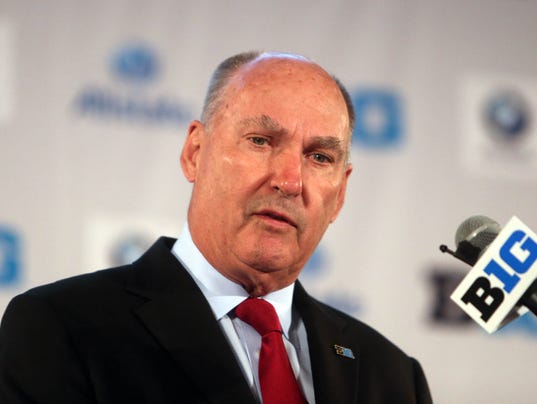
Maybe Jim Delany is Right
 |
| Photo: Jerry Lai/USA Today |
So I went into the reading of his white paper on freshman ineligibility (titled "Education First, Athletics Second") with a healthy dose of skepticisim. Granted, when he started talking about the idea of a "Year of Readiness" I had no clue exactly how much thought had gone into it.
I have to admit...I was surprised.
Not by the level of thought that was put into the paper, but by my inclination to agree with the points being made and actually being in support of the idea.
Monday, April 20, 2015
NCAA Reform Number One: Let Student Athletes Get Money On Their Own
When I first started going to college lo so many years
ago, I would have painted myself as firmly in the camp of stating that student
athletes who were receiving scholarships should not be paid. Period.
However, as I spent time on campus and then became a
higher education professional (and now part time sports blogger/analyst), my
position evolved and changed. Of course, the cost of attendance at most schools
around the country has spiraled out of control over the last 15-20 years.
Yes, an athlete is receiving, in some places, an education
valued at nearly $40,000/year or more (and possibly much more when some schools
start paying the full cost of attendance). The howls from those who believe
that student athletes should not receive any additional compensation grow loud.
The hurdle of Title IX is also in place as well, and as
costs increase across the board, important decisions are going to have to be
made in regards to the place of Olympic sports and their sustainability going
forward.
Of course, another option could have/should have been
pursued. It might not be any more than a patch, but it also reflects a reality
that, sadly, the NCAA brass and administrators seem to be missing.
Allow for the student athletes to receive their
scholarships, and also allow them to monetize outside of the scope of the
program.
In other words, let them profit off of their talent and
ability and the fame that comes along with that.
Subscribe to:
Posts (Atom)