Wednesday, August 26, 2015

A Look at a Hypothetical Major in Sports, Part III: Sophomore Year


(For Previous Entries in Series: Part One Part Two)

Sophomore year. A year that used to be overlooked in higher education circles until really the last decade. Plenty of research was done on the importance of the first year experience, and juniors and seniors received their fair share of analysis. But sophomore year was glossed over, even though at many places that is a milestone year—particularly for those who are planning on studying in majors at schools that limit entry to said majors. The application process for limited entry (or enrollment controlled) majors is usually during the second semester of sophomore year.

Doubt and what ifs creep in, and sophomores often find themselves adrift.

Sophomore slumps are real.

In the major, the sophomore year is focused on easing students into the major. The focus is still primarily on some general education requirements, but major field courses do make an appearance early on.

Tuesday, August 25, 2015

A Look at a Hypothetical Major in Sports Part II: Freshman Year — Not Quite "A Year of Readiness"


(For Part One of the series, click here.)

While Big Ten commissioner Jim Delany would rather have first year students endure "The Year of Readiness" and be automatically redshirted (and while I lean towards approval of that stance), let's operate under the assumption that all first year students could be immediately eligible.

The first year, and the first semester in particular, should be about the transition and orientation process. The most critical time for any student is during that first semester. Good habits and attitudes need to be established at this point, and the introduction to resources that can aid in that success is crucial.

We will examine the semesters separately. First up is the first semester:

Monday, August 24, 2015

A Look at a Hypothetical Major in Sports, Part I: Introduction


The tagline for an NCAA public service announcement in the mid-2000s was "...going pro in something other than sports."

And while it is true that the vast majority of student athletes will find career opportunities in fields such as medicine, education, and business, there are some who will go pro in sports and make a long career in the industry.

Why shouldn't those students, who see themselves as potential workers in the field of athletics (at the intercollegiate level and above) be encouraged to enter into a major—with a certain emphasis in the electives/additional required courses—that would allow these student athletes to gain access to the skills and knowledge base to be successful in the endeavor of sport?

This is a thought experiment; a mental exercise in trying to compose a major in sports that is a broad based approach to addressing the needs of people who are going to be employed as an athlete in a professional sports organization (either team or individual) and/or as an administrator after leaving the playing field.

Thursday, June 11, 2015

Brian Kelly Is Wrong. And He's Right, Too

Caught an interesting quote from Notre Dame head football coach Brian Kelly in this story from ND Insider (h/t: SB Nation). In it, Kelly states that basically, all of his football players are probably at-risk students:


I think we recognized that all of my football players are at-risk — all of them — really. Honestly, I don’t know that any of our players would get into the school by themselves right now with the academic standards the way they are. Maybe one or two of our players that are on scholarship.
So making sure that with the rigors that we put them in — playing on the road, playing night games, getting home at 4 o’clock in the morning, all of the demands that we place on them relative to the academics and going into an incredibly competitive academic classroom every day — we recognize this is a different group.
And we have to provide all the resources necessary for them to succeed and don’t force them into finding shortcuts.
I think we’ve clearly identified that we need to do better, and we’re not afraid to look at any shortcomings that we do have and fix them, and provide the resources necessary for our guys. Our university has looked at that, and we’re prepared to make sure that happens for our guys.
There's quite a bit to unpack there. Some hyperbole, and some truth.

Monday, June 1, 2015

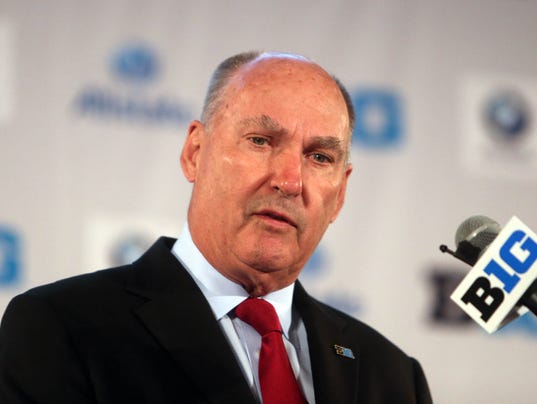
Maybe Jim Delany is Right

Photo: Jerry Lai/USA Today

I am not a huge fan of the Big Ten Commissioner Jim Delany. I've found him in the past to be excessively rigid, dogmatic and a hectoring sort of individual. This is not to say that he has not done good things, but I am not a fan of the man from what I have seen at a distance.

So I went into the reading of his white paper on freshman ineligibility (titled "Education First, Athletics Second") with a healthy dose of skepticisim. Granted, when he started talking about the idea of a "Year of Readiness" I had no clue exactly how much thought had gone into it.

I have to admit...I was surprised.

Not by the level of thought that was put into the paper, but by my inclination to agree with the points being made and actually being in support of the idea.

Monday, April 20, 2015

NCAA Reform Number One: Let Student Athletes Get Money On Their Own

When I first started going to college lo so many years ago, I would have painted myself as firmly in the camp of stating that student athletes who were receiving scholarships should not be paid. Period.

However, as I spent time on campus and then became a higher education professional (and now part time sports blogger/analyst), my position evolved and changed. Of course, the cost of attendance at most schools around the country has spiraled out of control over the last 15-20 years.

Yes, an athlete is receiving, in some places, an education valued at nearly $40,000/year or more (and possibly much more when some schools start paying the full cost of attendance). The howls from those who believe that student athletes should not receive any additional compensation grow loud.

The hurdle of Title IX is also in place as well, and as costs increase across the board, important decisions are going to have to be made in regards to the place of Olympic sports and their sustainability going forward.

Of course, another option could have/should have been pursued. It might not be any more than a patch, but it also reflects a reality that, sadly, the NCAA brass and administrators seem to be missing.

Allow for the student athletes to receive their scholarships, and also allow them to monetize outside of the scope of the program.

In other words, let them profit off of their talent and ability and the fame that comes along with that.

Tuesday, April 7, 2015

Maybe We Should Stop Calling Student Athletes Kids.

The 2015 NCAA Men's College Basketball Tournament wrapped up last night, with the Duke Blue Devils walking away with shards of a net, a new floor if they want it, and the satisfaction of a successful championship season being completed.

And they'll head either back to class or off to prepare for the next phase of their lives (even if that seems to annoy the senior Senator from Missouri for some reason. But that's another post.).

I consume a lot of sports media. Not as much as I used to, because I just have more important things to do, but more than a sane person probably should. And with my interest/expertise being in the realm of the college experience and intercollegiate athletics, I spend a lot of time reading about and listening to people blabber about college athletes.

I constantly hear sportswriters, analysts and commentators refer to the young men and women as "kids".

It irks me, to be quite honest.

Thursday, April 2, 2015

Colin Cowherd Would Rather Blow Out His Nonexistent Brain Than His Knee. OK.

Colin Cowherd is slime.

His reptilian, repugnant, race baiting and elitist approach to sports radio has been document multiple places multiple times (just go hit Google to find the list too long for me to link directly to).

But today’s commentary on what New England Patriots tight end Rob Gronkowski said during an interview on Jim Rome’s show on Showtime was too much.

Gronk basically said that he would rather suffer a knee injury or a concussion. Gronk’s response was, well, telling:

“[S]o if we’re sitting here and I had choose would I want a concussion right now or my knee blown out, I’m going to say a concussion. Why would I want to sit there for eight months and not do anything, when with a concussion I’ll just wake up and I’ll be ready to go again.”

Thank you Dr. Gronkowski.

Cowherd—that noted M.D., PhD and scholar—waded into the discussion as well. Some of his choice quotes were:

Make Sure You Fit As A Coach

Lots of jokes have been made about Larry Brown’s wandering eye.

Yahoo’s Pat Forde called Bobby Petrino “The Disingenuous Drifter” at one point for interviewing for job after job after job.

I even wrote a piece commenting on Mike Anderson leaving Missouri for Arkansas and mentioned the numerous flirtations he had racked up during his tenure in Columbia.

And each time the coaching carousel spins in college sports, the conversation about what is a good job/great job/best job in college football or basketball comes up.

I would not wish the itinerant wandering by most of the coaches upon anyone. Looking at the work histories of some longtime assistant coaches is enough to make you feel for them and their families, and the lack of roots somewhere is horrifying in many respects. It’s a hard life, no matter how much they may be compensated for the experience.

Unfinished Products Expected to be Great

I don’t know about you, but I know that I was not fully formed as a professional entering my field when I was 21. Hell, when I was 21 I was actually still in school getting the preparation I needed to become a professional in my chosen occupation.

Even at 31, I was not a fully developed professional; I still made a lot of mistakes.

Today as I am in the midst of the first week at a new job, at the tender age of 36 on the cusp of turning 37…I am still learning and growing and changing.

I know, I know. I am in the field of education and not in the field of professional athletics. Believe me, I am made aware of that fact each and every day as I look at my bank account and my car.

I still feel, though, that the point in my lede stands: expecting someone to be a fully developed, fully formed professional when one is barely old enough to drink in most circumstances is ludicrous.

Yet when it comes to professional sports, and football in particular, that ludicrous notion seems to be the expected norm.

Wednesday, April 1, 2015

Dodd-ering Through the Impotent Rage of the Spurned Sportswriter

I’ve been amused by the idea that a certain member of the sports media felt entitled to an interview by an NFL player and took to Twitter very pissed off that he was denied the interview by the athlete.

Dennis Dodd of CBS Sports got salty for no reason after Aaron Rodgers declined his request for an interview. The entitlement that dripped from Dodd’s series of tweets was somewhere in the neighborhoods of amusing, sad and pathetic.

What got to me, though, was the fact that Dodd also seemed to be pissed off that Rodgers was on the floor for the celebration and then had the audacity to not want to speak to Dodd, someone who thinks of himself as a kingmaker, apparently, because he writes about people who play games for their education/vocation.

Tuesday, January 13, 2015

A Fever Dream Leads to a Return

I tossed and turned.

I was finding it difficult to get comfortable, as all these thoughts kept running through my head.

A quote from William Shakespeare: "It is a tale told by an idiot/full of sound and fury, signifying nothing" is followed by a video clip of Skip Bayless and Stephen A. Smith shouting vile, nonsenical things at each other.

An adage: "Better to remain silent and be thought a fool than speak and remove all doubt" is followed by images of the clickbait written by Clay Travis.

A quote from Sir Arthur Conan Doyle's famous detective Sherlock Holmes: "It is a capital mistake to theorize before one has data. Insensibly one begins to twist facts to suit theories instead of theories to suit facts" is followed by the sound of Colin Cowherd's nasal whine spewing forth all kinds of utter nonsense.

The swirling noise forced me to sit up and assess some things.

Why is it that those who yell the loudest these days get the attention that quieter, more competent people cannot? All the racebaiting and women hating drives eyeballs and ears to the televisions and the web. Traffic is king, I guess.

Trolling is easy and lazy to do. Make an outlandish outrageous statement and voíla-instant fame. 

I guess I want more. I guess I expect more. 

Can I bring more to the table? I don't know. But in this space I hope to accomplish more by shedding light on inane statements and nonsenical theories that seem to be circulating relatively unopposed. 

I won't be able to cover everything; I am only one person who has a family and a full-time job. And there is a lot of noise out there.

But by golly, we will try.